
Aurora forecast · iPhone
The northern lights forecast that says no when the answer is no.
Lumavik reads NOAA space weather and turns it into one honest number for where you are standing — then wakes you up when the aurora is actually worth going outside for.
Free forecast, forever NOAA SWPC data No account
At this Kp, aurora typically reaches down to about — corrected geomagnetic latitude — which is not the same as your map latitude. Find yours, or read what Kp can and cannot tell you.
Why another aurora app
Everyone reads the same data. Almost nobody reads it honestly.
Every aurora app on both stores pulls the same free feeds from the NOAA Space Weather Prediction Center. There is no secret forecast and no proprietary model, and any app claiming otherwise is selling you something. What separates a useful aurora app from a disappointing one is not the data. It is what happens between the data arriving and a number appearing on your screen.
Kp is not your Kp
The K-index is a planetary average over three hours. Repackaging it as a local score is the most common shortcut in this category, and it is why an app can show a promising number while nothing at all is happening over your longitude. Lumavik scores against your corrected geomagnetic latitude, which is the coordinate the aurora actually cares about.
An alert you got out of bed for
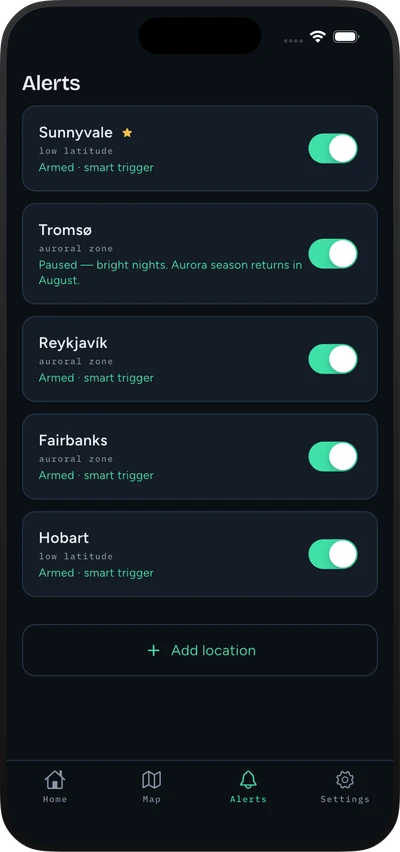
A push notification that sends someone into a field at 1am to see nothing is the fastest way to lose a user permanently. Lumavik's alert threshold accounts for whether it is dark where you are and whether you are close enough to the oval for the forecast activity to reach you. Fewer alerts. Better ones.
Every score shows its weak link
A forecast is a chain, and it is only as good as its worst link. Lumavik names that link with every score — not enough activity, not dark enough yet, too far from the oval, or data that has gone stale. You always know which part of the answer to distrust, which is what makes the rest of it worth trusting.
In the app
One screen that answers the question, and the detail underneath it.
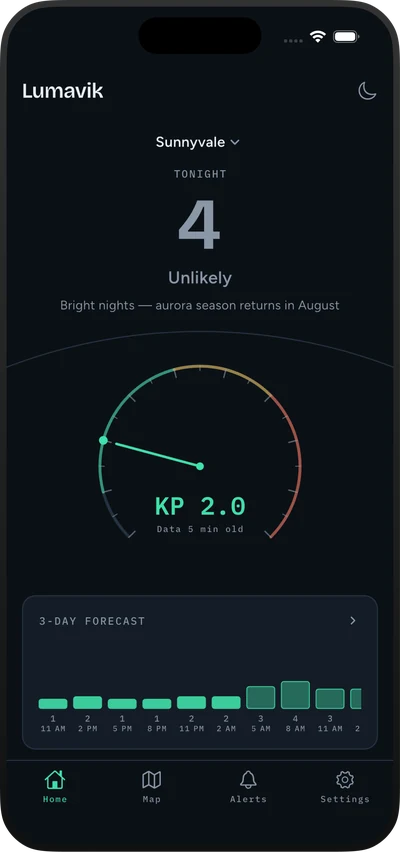
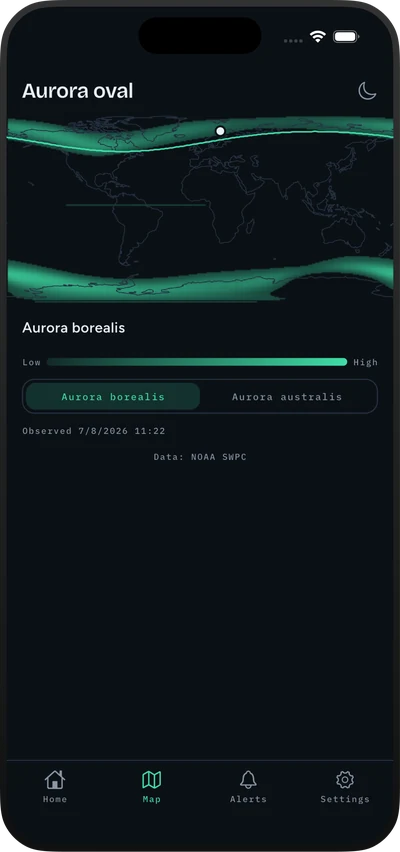
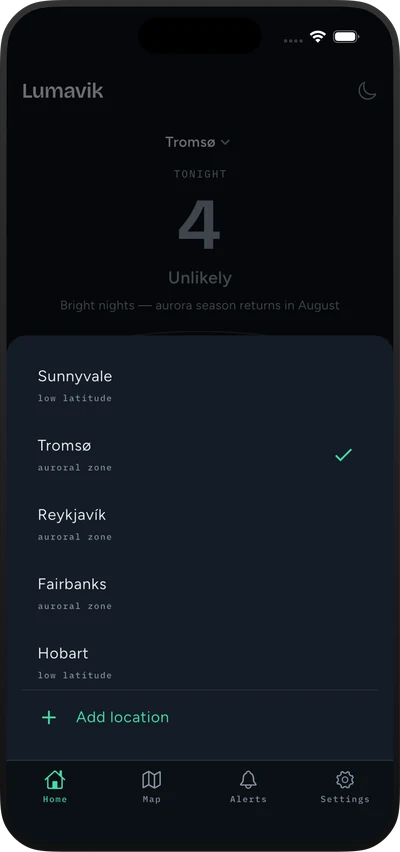
The home screen exists to settle one thing quickly: is tonight worth it. The score, the current Kp, the data age and the limiting factor sit together so the answer takes about two seconds. Everything else — the oval map, the hourly timeline, the three-day outlook, the solar wind — is there when you want to understand the answer rather than just receive it.
How the forecast is built
Four things have to agree before you see anything.
This is worth understanding whichever app you end up using, because it explains almost every disappointing aurora night. The chance of a sighting is not one variable. It is four, and the weakest one wins.
Is the magnetosphere disturbed?
Solar wind carries a magnetic field. When that field points south it can reconnect with Earth's own field and pour energy into the polar regions. That energy is what the Kp index measures, several hours after the fact, as a planetary average. The detailed version lives in the solar wind data, where a southward Bz at moderate speed beats a fast wind pointing north every time.
Are you close enough to the oval?
The aurora forms a ring around the geomagnetic pole, not the geographic one, and that pole is offset — which is why northern Scotland sees displays that much of Russia at the same map latitude does not. Your corrected geomagnetic latitude sets the minimum Kp you need before the ring reaches you at all.
Is your sky dark enough yet?
The aurora does not stop in summer; the sky simply never gets dark enough to show it. Above the Arctic Circle that closes the season for months, and it closes it for longer the further north you go — which is why Reykjavik has a longer usable season than Tromsø. The season explainer works through the twilight arithmetic.
Can you see the sky at all?
Cloud has an absolute veto and no forecast model can overrule it. A perfect Kp 7 under complete overcast is a nothing night. This is the single largest cause of the gap between what an app promised and what someone saw, and it is the reason Lumavik reports its limiting factor rather than a bare number.
Magnetic midnight, not clock midnight
The oval is fixed relative to the sun while the Earth rotates underneath it, so every location passes through the most active part of the ring at a predictable local time — usually somewhere between 10pm and 2am, shifted by your longitude within your time zone. The oval explainer covers what that means for when to go out.
What it looks like to your eyes
Photographs are greener than reality, and that is physics rather than editing: a camera integrates light over several seconds while dark-adapted human vision is nearly colourblind. A faint display often reads as a grey arc to the eye and a vivid green band on a phone. Knowing that in advance turns a disappointment into a good night. The colour explainer covers the mechanism.
Free, in your browser
Space weather tools with no app and no account.
These run on the same public NOAA feeds the app uses. They are free, they work on any device, and nothing you type into them leaves your browser.
Live aurora forecast
Current Kp, the 3-day NOAA outlook and what each number means for your latitude. No sign-up, no app required.
Open the tool →Can I see it tonight?
Enter a place. Get a straight verdict built from geomagnetic latitude, the forecast and how dark it gets tonight.
Open the tool →Geomagnetic latitude
The number that actually decides your aurora odds, and the minimum Kp you need at your location.
Open the tool →Camera settings
Exposure worked out from the display you are looking at, not a fixed recipe copied from a blog post.
Open the tool →Dark-hours calendar
When your sky is dark enough to see anything, month by month — the constraint that ends the season in summer.
Open the tool →Pricing
The forecast is free. Pro is for people who chase.
The core answer — tonight's chance, the current Kp, the three-day outlook, the oval map and one alert location — is free and is not going behind a paywall. Pro exists for people who plan trips around this and want to tune it.
Free
- Tonight's chance for your location
- Live Kp and the 3-day NOAA outlook
- Auroral oval map
- One saved location with alerts
Pro
- Custom alert thresholds, so you decide what is worth waking up for
- Several saved locations for trips
- Hourly timeline and solar wind detail, including Bz
- No ads
Cancel any time. The trial costs nothing.
Questions
Straight answers about aurora forecasting.
Is Lumavik free?
Yes. The forecast, the Kp index, the 3-day outlook, the auroral oval map and one alert location are free and stay free. Pro adds custom alert thresholds, several saved locations, the hourly timeline and solar-wind detail, and removes ads — $2.99 a week or $19.99 a year with a 7-day free trial. The forecast itself is never paywalled.
Where does the aurora data come from?
From the NOAA Space Weather Prediction Center: the planetary K-index, the 3-day geomagnetic forecast, the OVATION auroral-oval model and real-time solar wind measured by spacecraft at the L1 point. That data is public domain and free, which is why every serious aurora app uses it. What differs between apps is how honestly it gets turned into an answer for one person standing in one place.
Will Lumavik tell me if I can see the aurora from my exact location?
It gives you a probability, not a promise. The score combines the forecast Kp with your corrected geomagnetic latitude, how dark it is where you are, and where you sit relative to the auroral oval. It cannot see your sky, so cloud cover has the final say — and Lumavik tells you when cloud is the limiting factor instead of quietly ignoring it.
How accurate is an aurora forecast?
Accuracy depends almost entirely on lead time. The 30-to-60-minute nowcast is genuinely good, because it is based on solar wind measured upstream at L1 and about to arrive. The 3-day forecast is a coarse probability. The 27-day outlook is a recurrence pattern, not a prediction about a specific night. Any app that presents all three with the same confidence is misleading you.
Does the app work in the southern hemisphere?
Yes. The aurora australis runs on the same physics and the same NOAA data, and displays occur in both hemispheres at the same time. The practical difference is geography: the southern auroral oval sits mostly over ocean and Antarctica, so Tasmania, Stewart Island and the far south of New Zealand are the realistic viewing locations.
Do I need to be somewhere far north?
Not always. During a strong geomagnetic storm the auroral oval expands a long way equatorward, which is how aurora ends up visible from Scotland, the northern United States and northern Germany. What matters is your corrected geomagnetic latitude rather than the latitude printed on a map, and the two can differ by several degrees depending on your longitude.
Why does the app sometimes say the answer is no?
Because the honest answer is often no, and an alert that fires when nothing is visible is the fastest way to make people stop trusting an aurora app. Lumavik shows its limiting factor with every score: too little activity, too much daylight, or the wrong latitude. A quiet night reported as quiet is the feature, not a failure.
Is there an Android version?
Not yet. Lumavik is on iPhone today and an Android build is planned. The free tools on this site work in any browser on any device in the meantime, including the live forecast on this page.
Skywatch
Aurora forecasting, explained properly.
We write the explainers we wanted when we were building the forecast engine: what the numbers mean, where the models break, and how to plan around them. Read the whole section.
Aurora glossary: the space-weather terms defined
Forty aurora and space-weather terms defined — Kp, ap, Dst, Bz, OVATION, substorm, geomagnetic latitude, IBC, STEVE — each with what it changes for someone standing outside.
Aug 7, 2026Aurora forms and names: what you are looking at
The standard classification for what you are looking at: homogeneous and rayed arcs, bands, rays, the corona, the four-step brightness scale, and where STEVE sits outside it.
Aug 7, 2026The auroral substorm: why a quiet arc suddenly explodes
A substorm is why a quiet arc suddenly fills the sky and is gone twenty minutes later. The three phases, how long each lasts, and why a three-hour Kp value hides them.
Get told when it is worth going outside.
Free on iPhone. The forecast, the map and one alert location cost nothing, and the app never asks you to make an account.